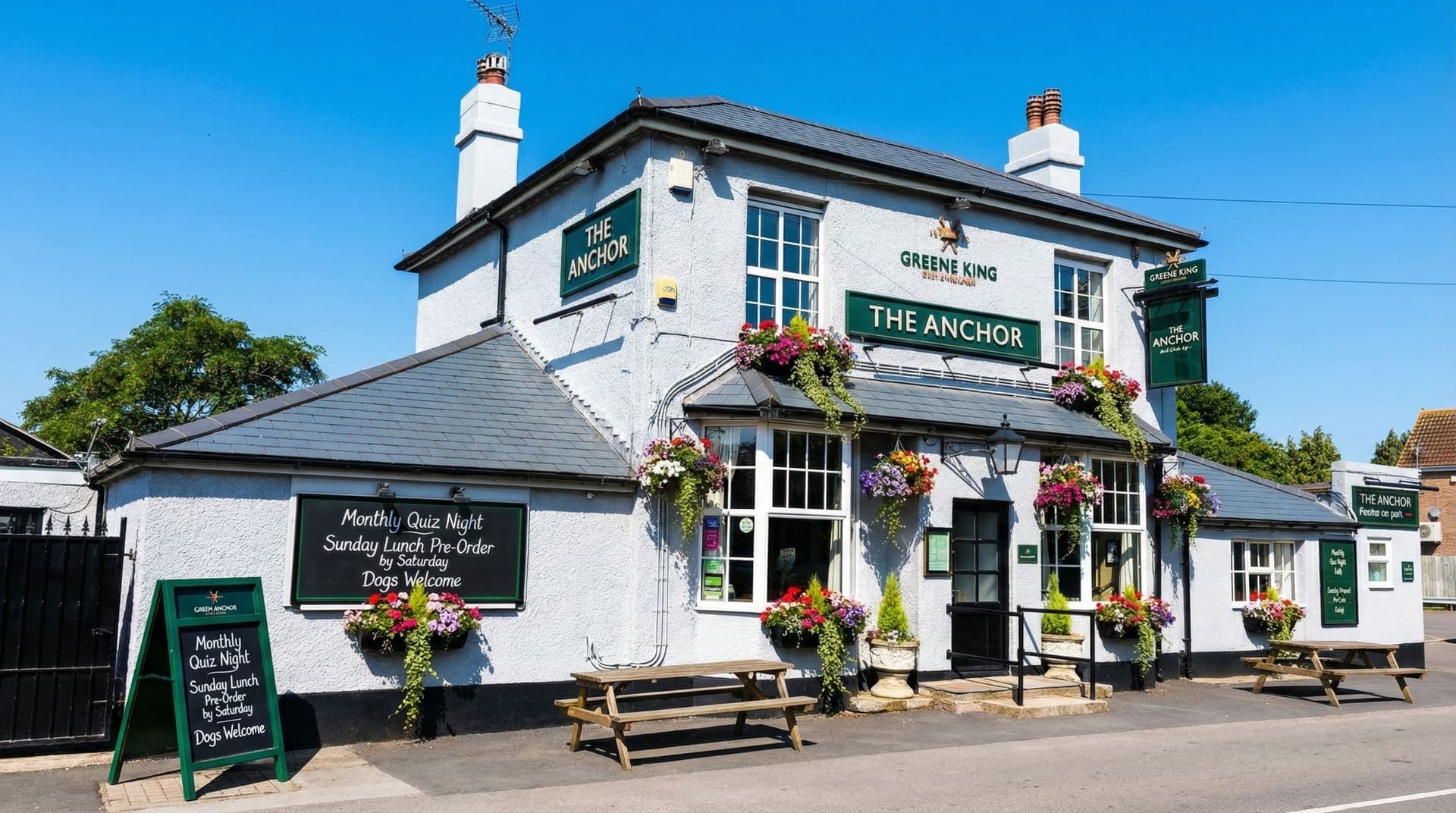
The History of The Anchor
A village pub in Stanwell Moor since at least 1751
A Pub on the Moor Since at Least 1751
Nearly three centuries of pouring pints and welcoming strangers
The Anchor is more than a pub near Heathrow. It is one of Stanwell Moor's oldest landmarks, a village local with roots reaching back through centuries of rural life, family stories, wartime loss and community gatherings.
The pub's own history gives an establishment date of 1751, and local historic records suggest that an Anchor Inn was already present in Stanwell Moor by 1730. The building standing today is believed to be mid-Victorian, built on the site of that earlier inn. The story of The Anchor is older than the present walls.
In 2004, Spelthorne Borough Council locally listed The Anchor (reference LL/072), recognising its architectural and historic interest. The listing describes it as a mid-Victorian pub with a two-storey hipped-roof main building, single-storey side wings, a central porch and bay windows, standing at the junction opposite Horton Road.
Auctions, Blacksmiths and Working Village Life
Long before anyone dreamed of building an airport next door
Long before the sound of aircraft overhead, Stanwell Moor was a working village of farms, mills, cottages, horses and carts. The Anchor stood at the heart of that life. In 1813, a nearby smithy and cottage were put up for auction at the pub. Local history records describe The Anchor as a key village landmark, routinely used for public events such as auctions.
The pub's link with the blacksmith trade gives a glimpse of the old village. Before motor vehicles, local farms, carts and mills depended on horses and repairs. In 1861, a blacksmith named William Webb was recorded at The Anchor, with enough work to employ a colleague. By 1915, a former forge adjoining The Anchor Inn was being offered for sale, marking the fading of a trade that had once been central to village life.
The Publicans of The Anchor
The families who called this pub home
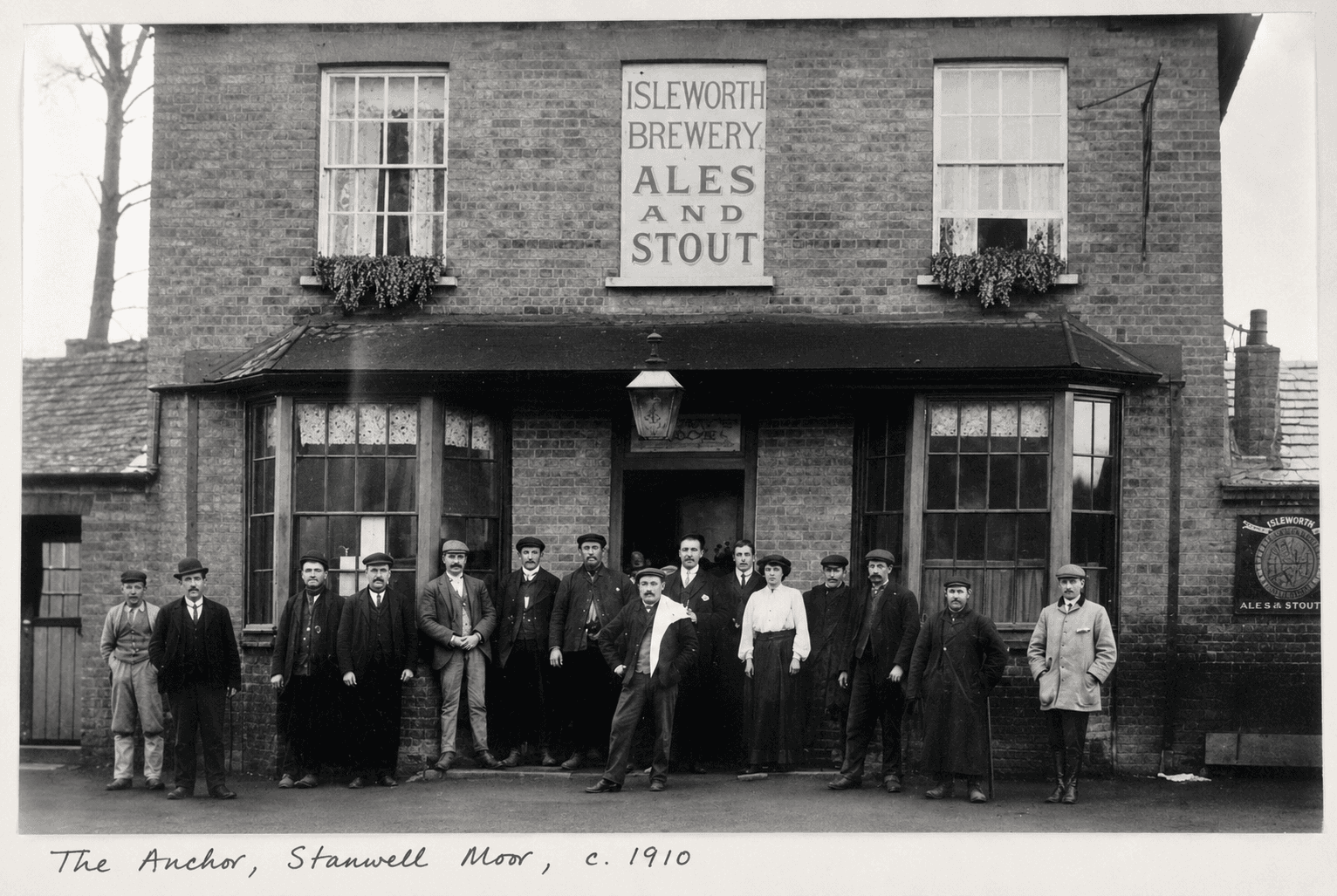
The Anchor around 1910, in its Isleworth Brewery days
Victorian records bring some of The Anchor's early publicans into view. J Lintill is recorded at the pub in 1855, one of the earliest named people connected directly to The Anchor after the 1730 evidence.
The Sidwell family appears through the second half of the nineteenth century. R F Sidwell is listed in 1866, then Edwin Sidwell in the 1870s and 1880s. In the 1881 census, Edwin Sidwell was described as a licensed victualler, aged 38, born in Stanwell. His household included his wife Fanny, children Amy Gertrude, Ernest Walter and Bertie Alfred, and a 14-year-old domestic servant. The Anchor was not just a bar. It was a family home, a workplace and a place where servants, boarders, travellers and locals crossed paths.
Mrs Mary Ann Benn is recorded through the 1890s. In the 1891 census she is listed as landlady, aged 50, born in Hampton Wick, with a visitor and a boarder from Denham in her household. Mary Ann Benn and Sarah Cooper, who followed her, give The Anchor a strong thread of women running the pub, a fact that a lot of pub histories overlook.
Known Publicans and Key Dates
Sarah Cooper, Family Memory and the Loss of Harry Cooper
A family address, a wartime loss and memories passed down
Sarah Cooper, nee Austin, is one of the most important names in The Anchor's story. She is recorded as landlady from at least 1914 through to 1937. A descendant's family-history account adds that Sarah was still at The Anchor in 1939 with Charlie and Lal Eeles, and that she was still living at the pub when she died in 1947. Earlier family history says William and Sarah Cooper became landlords around 1902, with Sarah running the pub while William worked elsewhere during the day. After William died in 1907, Sarah continued as licensee with help from her family.
That same account also links the Cooper story to the Beal family. Sarah Jessie Cooper (1866–1918), Sarah Cooper's daughter, and William Beal (1866–1945) had a son, Frederick Beal (1895–1973). Frederick's son, Denys Beal (1923–2006), clearly remembered visiting family at The Anchor, a reminder that the pub was not only a licence and a business. It was a family home.
Sarah's story is also tied to one of the saddest episodes in the pub's history. Her son, Harry Cooper, was a railway worker before the war. A family account says he often drank in his mother's pub and was friends with George Slade. According to that account, a remark made in the pub about men in protected railway jobs being cowards angered Harry enough to volunteer for service.
Harry joined the Royal Navy in 1916 and served as a Stoker 1st Class on HMS Vanguard. On 9 July 1917, HMS Vanguard was destroyed by an accidental internal explosion at Scapa Flow. 843 men were lost and only 2 survived. Harry was 33 years old.
The Commonwealth War Graves Commission records Harry as the son of William and Sarah Cooper of “The Anchor Inn,” Stanwell Moor, Staines. A remark made in this pub sent a young man to war, and his name came back on a casualty list to the same address.
The Eeles Family and Village Memories
Football, families and the village local
The Eeles family is another important part of The Anchor's story. A 1922 London Gazette notice places Charles Edwin Eeles at “The Anchor Inn, Stanwell Moor, Staines, Middlesex.”
Later, a 1951–52 photograph of Stanwell Moor Football Club cup winners, likely taken at the side of The Anchor, identifies Charlie Eeles with the pub. The Anchor was not just a drinking place. It was a backdrop to village sport, local pride and community photographs.
Local memories connect Charlie and Lal Eeles with The Anchor across the middle decades of the twentieth century. The photograph here shows them behind the bar, with Watney's Special Mild, Carlsberg and Ben Truman on the pumps, a snapshot of a proper village local in its heyday.
A family-history contribution has also helped explain the continuity between the Cooper and Eeles years. The family tree records Lal's given name as Norma and links her to Sarah Cooper as Sarah's daughter, suggesting that The Anchor remained within the wider family after Sarah's time as landlady.
We are still gathering dates and memories from the Eeles period. If you have photographs, stories or family connections, we would love to hear from you.
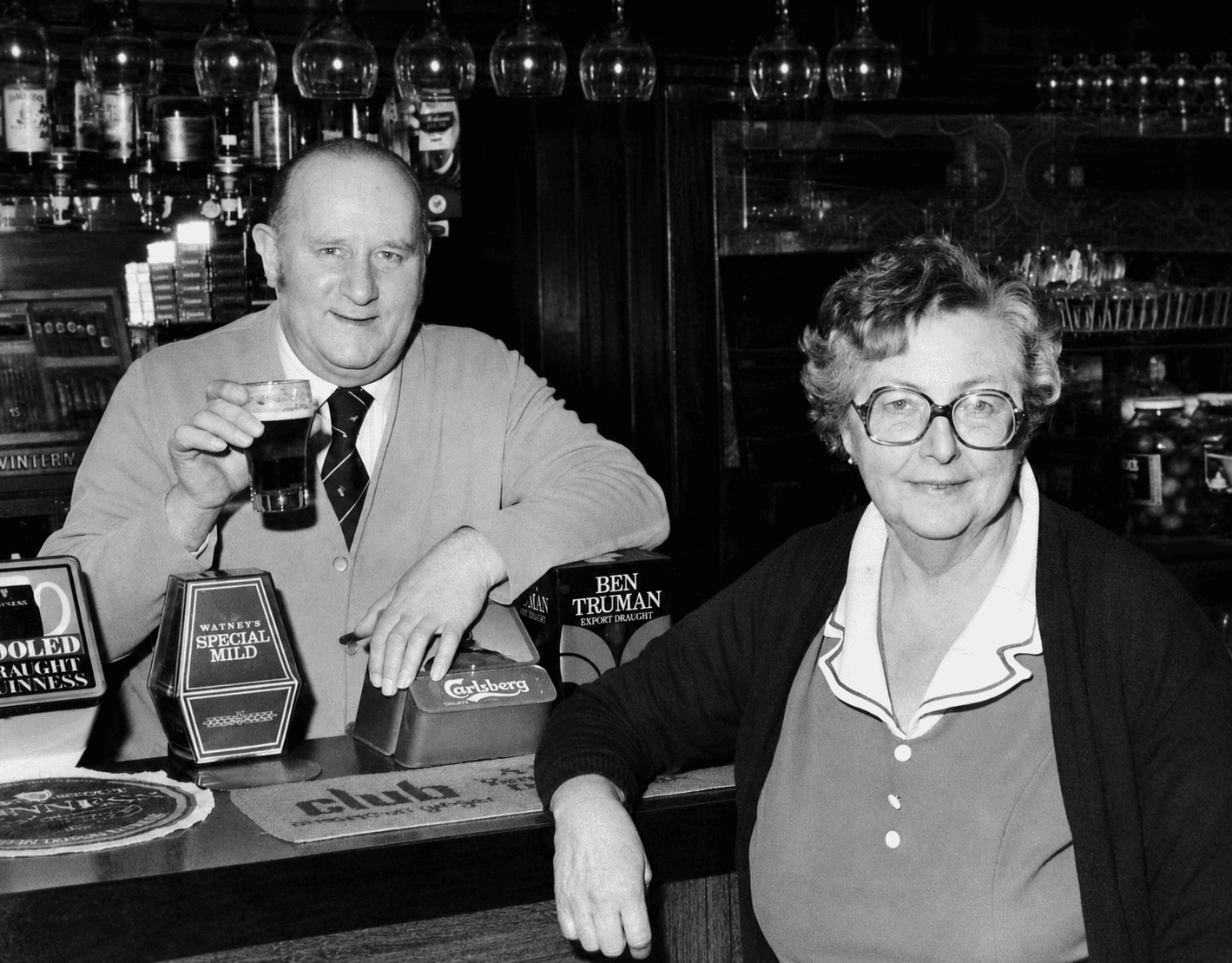
Lal and Charlie Eeles behind the bar at The Anchor
Lal's Prayer
Written by Lal Eeles, landlady of The Anchor
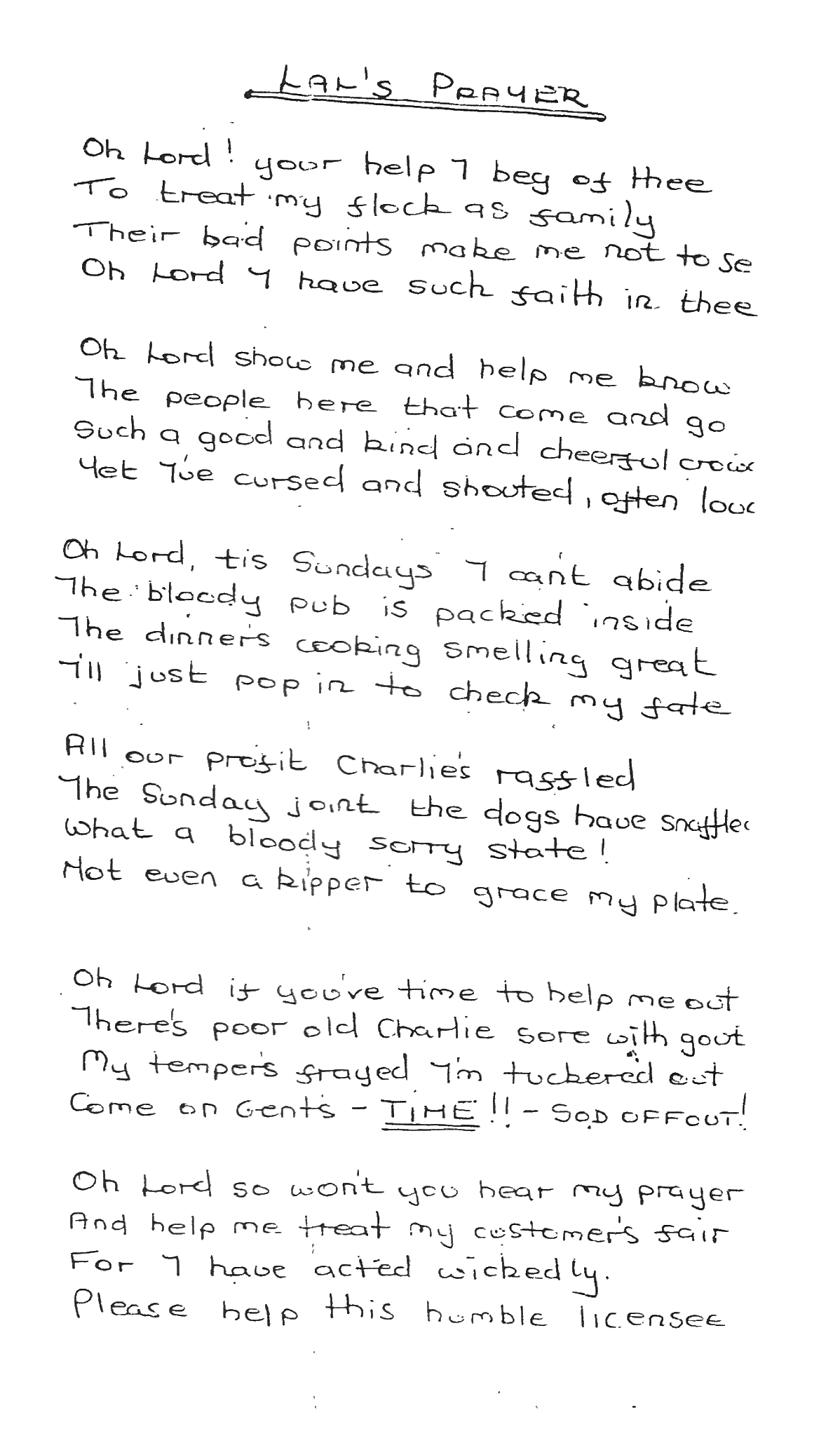
The original handwritten manuscript
Read transcript
Oh Lord! Your help I beg of thee
To treat my flock as family
Their bad points make me not to see
Oh Lord I have such faith in thee
Oh Lord show me and help me know
The people here that come and go
Such a good and kind and cheerful crew
Yet I've cursed and shouted, often loud
Oh Lord, tis Sundays I can't abide
The bloody pub is packed inside
The dinners cooking smelling great
I'll just pop in to check my fate
All our profit Charlie's rassled
The Sunday joint the dogs have snaffled
What a bloody sorry state!
Not even a kipper to grace my plate.
Oh Lord if you've time to help me out
There's poor old Charlie sore with gout
My temper's strayed I'm tuckered out
Come on Gents. TIME!! Sod off out!
Oh Lord so won't you hear my prayer
And help me treat my customers fair
For I have acted wickedly.
Please help this humble licensee
Buses, Heathrow and a Changing Village
From a horse-powered moor to the world's busiest flight path
By the 1950s, The Anchor was still very much part of village life. A Francis Frith photograph from around 1955 shows the pub as it looked then, and Stanwell Moor History Group has compared that old view with a modern photograph looking north-west from Horton Road.
The second half of the twentieth century changed Stanwell Moor. Roads were widened, reservoirs were dug, and Heathrow grew from a grass airstrip into one of the world's busiest airports. After the Staines West to West Drayton railway line closed in 1965, the London Country 444 bus route served Stanwell Moor, with The Anchor as one of the main stops. In 1977, the Golden Miller 606 also picked up at the pub.
For some villagers, The Anchor was not only where you went for a drink. It was the place you got the bus.
The Anchor Today
A village pub in the shadow of the world's busiest airport
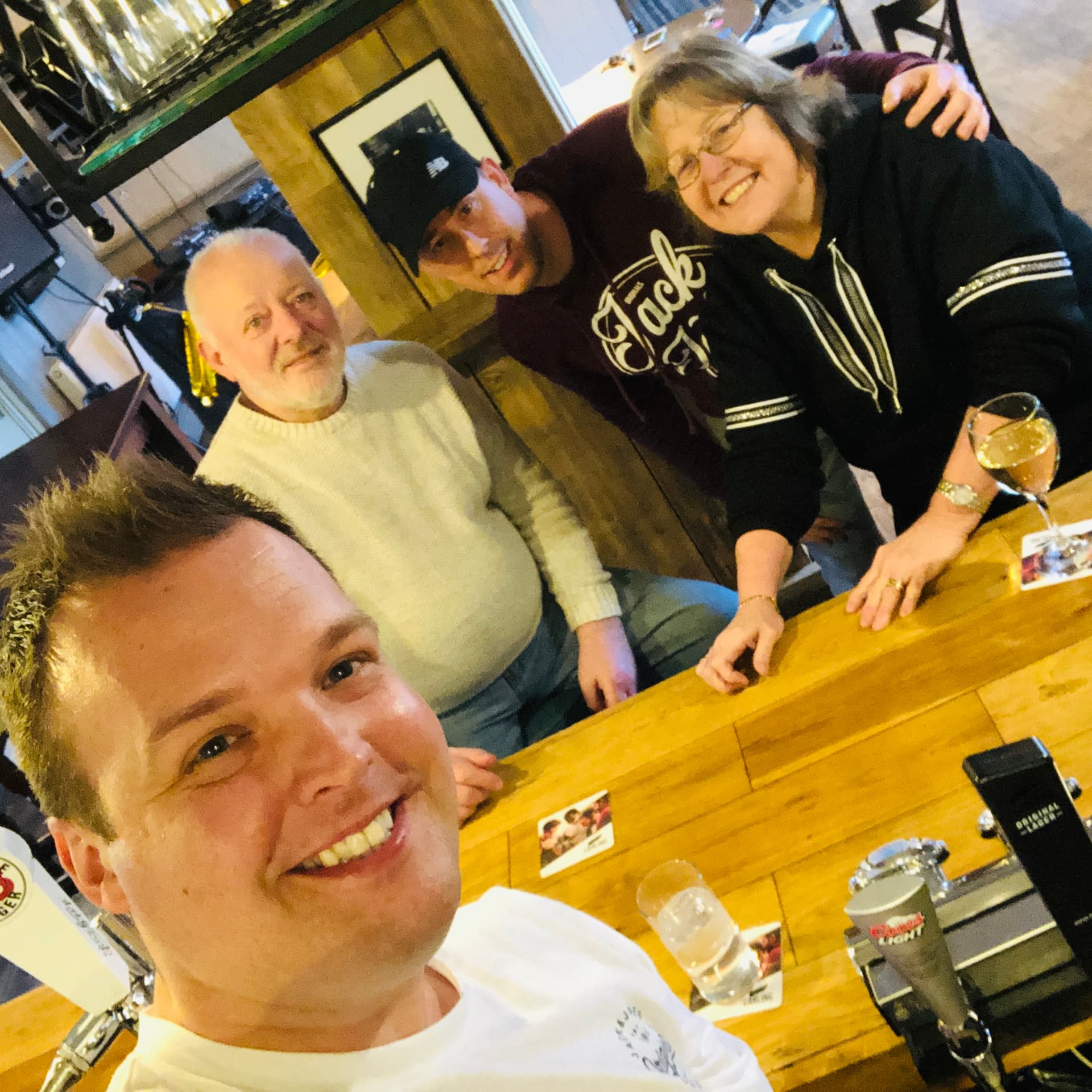
Handover day, 5 March 2019, Martine and Ronnie's last drink and Billy and Peter's first
Today, The Anchor has a new identity as a traditional village pub beside Heathrow. It is just seven minutes from Terminal 5, with a beer garden under the flight path, free parking and a warm welcome for locals, travellers, families, dogs and plane spotters.
The flight path that runs over the beer garden turned out to be one of the best things about the place. Planes pass overhead every 90 seconds during peak times, and what started as background noise became a genuine attraction. People come from miles around to watch A380s and Dreamliners descend while enjoying a cold pint.
But behind the modern Heathrow setting is a much older story: an inn on the moor, a Victorian pub, a blacksmith's neighbour, a family home, a wartime memory and a meeting place for generations of Stanwell Moor people.
We have our quiz nights, music bingo and karaoke. The kids play in the garden while the dogs snooze under the tables. The kitchen turns out honest British food, and on Sundays we serve proper roasts with all the trimmings. That's what we've been doing since George II was on the throne, and we don't plan on stopping.
Share Your Memories of The Anchor
Help us tell the full story
We know there are gaps in this story, particularly around the Eeles years and the mid-twentieth century. If you have photographs, dates, family connections or memories of The Anchor, we would love to hear from you. Every detail helps us piece together the full history of this village pub.
History of The Anchor: Questions & Answers
Come and See for Yourself
Book a table, grab a pint, or just pop in and say hello. We've been here since 1751, we're not going anywhere.
Horton Road, Stanwell Moor, Surrey TW19 6AQ · 7 mins from Heathrow T5 · Free parking